1 lien privé
Used in conjunction with ReSpec


- description : The Open Digital Rights Language (ODRL) is a policy expression language that provides a flexible and interoperable information model, vocabulary, and encoding mechanisms for representing statements about the usage of content and services. The ODRL Information Model describes the underlying concepts, entities, and relationships that form the foundational basis for the semantics of the ODRL policies.

Data facade standardisation community group
Related to SPARQL anything
Activity stream ontology
This document describes the lexicon model for ontologies (lemon) as a main outcome of the work of the Ontology Lexicon (Ontolex) community group.
Reconciliation API specification
The Data Privacy Vocabulary [DPV] enables expressing machine-readable metadata about the use and processing of (personal or otherwise) data and technologies based on legislative requirements such as the General Data Protection Regulation [GDPR]. This document describes the DPV specification along with its data model. The canonical URL for DPV is https://w3id.org/dpv which contains (this) specification. The namespace for DPV terms is https://w3id.org/dpv#, the suggested prefix is dpv, and this document along with source and releases are available at https://github.com/w3c/dpv. A changelog this version is provided in the appendix.
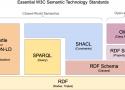
For newcomers into the world of semantic technology and knowledge graphs, the diagram above illustrates some of the key languages that you may want to look into. RDF RDF defines the very lowest level building blocks of how graphs can be represented.
This document describes a core ontology for organizational structures, aimed at supporting linked data publishing of organizational information across a number of domains. It is designed to allow domain-specific extensions to add classification of organizations and roles, as well as extensions to support neighbouring information such as organizational activities.
The namespace for all terms in this ontology is: http://www.w3.org/ns/org#
This document defines the Simple Knowledge Organization System (SKOS), a common data model for sharing and linking knowledge organization systems via the Web.
Many knowledge organization systems, such as thesauri, taxonomies, classification schemes and subject heading systems, share a similar structure, and are used in similar applications. SKOS captures much of this similarity and makes it explicit, to enable data and technology sharing across diverse applications.
The SKOS data model provides a standard, low-cost migration path for porting existing knowledge organization systems to the Semantic Web. SKOS also provides a lightweight, intuitive language for developing and sharing new knowledge organization systems. It may be used on its own, or in combination with formal knowledge representation languages such as the Web Ontology language (OWL).
This document is the normative specification of the Simple Knowledge Organization System. It is intended for readers who are involved in the design and implementation of information systems, and who already have a good understanding of Semantic Web technology, especially RDF and OWL.
The PROV Ontology (PROV-O) expresses the PROV Data Model [PROV-DM] using the OWL2 Web Ontology Language (OWL2) [OWL2-OVERVIEW]. It provides a set of classes, properties, and restrictions that can be used to represent and interchange provenance information generated in different systems and under different contexts. It can also be specialized to create new classes and properties to model provenance information for different applications and domains. The PROV Document Overview describes the overall state of PROV, and should be read before other PROV documents.